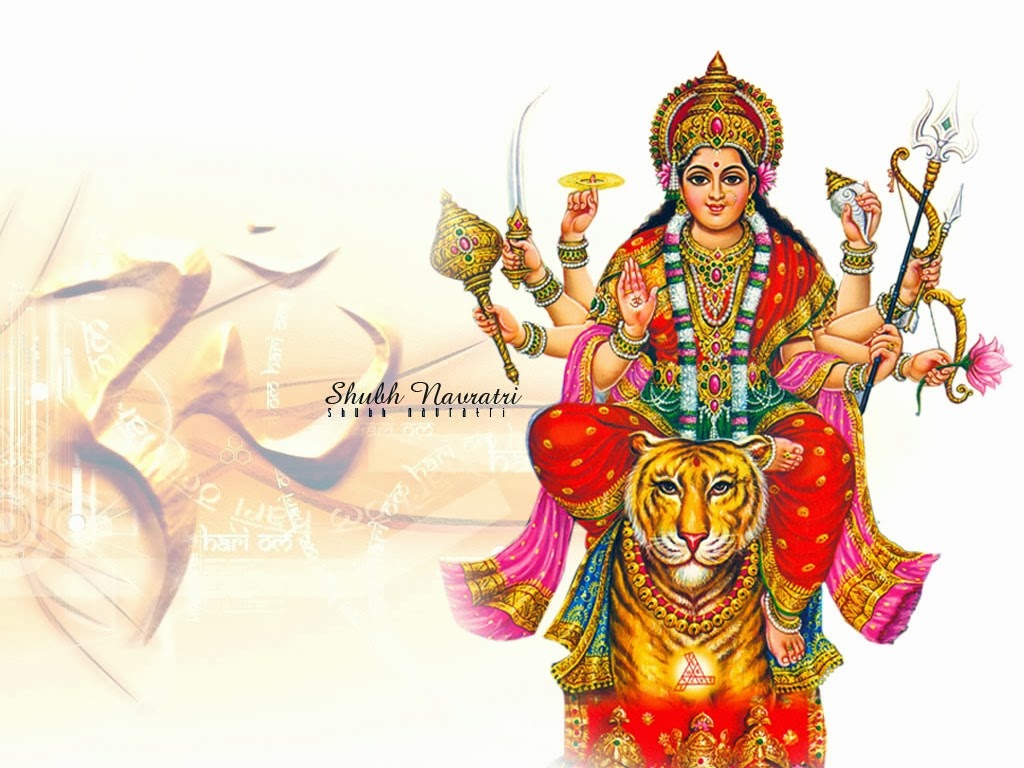
Navratri Pujan


The Hindu festival of Navratri is celebrated twice a year. The first Navratri of the year is known as Chaitra Navratra, as it falls in March-April. The second Navratri is held in October-November, which coincides Durga Puja. The nights of Navratri are devoted to the reverence of Goddess Durga, who is worshipped in many forms. Prayers are offered to Goddess Durga, as she is considered the manifestation of the absolute energy that pervades the Universe. All through the nine days, the devotees would chant mantras, sing songs and bhajans in the praise of the deity. Fasting on Navratri is considered auspicious. To celebrate the festival, a number of pujas are conducted all through the nine days. Go through the following lines to get the vidhi (procedure) of Navratri puja.

Also View: Mata Rani Navroop (9 Roop of Mata Rani)

Navaratri Puja Vidhi

Certain items are required to perform the Navratri puja. These may include the idol or picture of Goddess Durga, Durga Sapthashati book, water in Kalash (pitcher), fresh washed mango leaves, one coconut, roli (red color for tilak), moli (red sacred thread), chawal (rice), paan (betel leaves), supari (beetle nuts), cloves, cardamom, kumkum (vermilion) and gulal. You will also need few incense sticks, a deep and matchstick. The flowers used for Navratri puja may include rose, lotus and red hibiscus. Stalks of Bilwa (bael) leaves are also used for the puja. You may offer fresh pomegranate and sweets such as laddoo and peda, as prasad. You will require a Panchpatra containing spoon and water, bael leaves. Take a mat as well, to sit.

In order to perform the puja, take bath in the morning and wear laundered clothes. Then, fill the kalash with water and place mango leaves on its mouth. Place a coconut inside the kalash. Now, tie moli on the neck of the pitcher. Place the idol or picture of Maa Durga at your puja room and then worship the deity with roli, rice, flowers, balepatra, kumkum and gulal. Thereafter, you may add burning coal to a clay pot and pour ghee (clarified butter) over it. Offer a small piece of the sweetmeat to the fire. Keep adding ghee to the fire at regular intervals. Make sure that you maintain the light throughout your puja. Once the puja is over, fold your hands and encircle the flame for three times. Light the incense sticks and deep and perform the aarti. You may sing arti song while doing the aarti. You may chant Durga Saptashati or Devi Kavach or ask a pundit to do it, to conclude the puja.


Navratri Fast

The Navratri fast is observed from the first day to the ninth day. Some devotees only observe fast during three days i.e., first fast during any one of the first three days and second fast during any one of the next three and last in any one of final three days. Some people confine to milk and fruits during the nine days. Most devotees take a single meal during the day. Non-vegetarian & tamsik (onion, garlic, etc) food is totally avoided.


Navratri Dishes
  • Kuttu/Singhara Poori
  • Kuttu/Singhara Pakori
  • Fried Aloo
  • Fruit Chaat
  • Sabudana Khichadi
  • Makhane Ki Subzi
  • Sawank Ke Chawal
  • Dahi Pudine Wale Aloo
  • Makhane Ki Sabzi
  • Shakarkandi Ki Chaat
  • Sabudana Papad
  • Aloo Raita
  • Banana Chips
  • Fruits/Fruit Juices
  • Sabudana Khir
YOU MAY LIKE:

Navratri Wallpapers


Karva Chauth: Festival of Love

The Legends of Karva Chauth


Queen Veeravati - Long time ago, there lived a beautiful girl by the name of Veeravati. She was the only sister of her seven loving brothers, who was married to a king. On the occasion of the first Karva Chauth after her marriage, she went to her parents' house. After sunrise, she observed a strict fast. However, the queen couldn't stand the rigors of fasting and was desperately waiting for the moon to rise. The seven brothers, who loved her dearly, were very disturbed watching the distress of their sister and decided to end her fast by deceiving her. Then the brothers reflected a mirror through Pipal tree leaves. The sister, taken it as moonrise, broke the fast and took food. However, the moment the queen ate her dinner, she received the news that her husband, the king, was seriously ill. She did not keep the fast properly. When Veeravati begged forgiveness, Goddess Parvati granted that her husband would revive only when she completes her fast under strict conditions. The queen observed the fast and thus revived the life of her husband.

Satyavan and Savitri - Another story id of the Satyavan and Savitri. Once Yamraj - the God of Death came to take Satyavan's life. Savitri - the devoted wife of Satyavan pleaded for her husbands life which Yamraj refused. Savitri went on a fast and refused to eat or drink. Looking at her devotion, Yamraj was forced to grant life to Satyavan. Since then women started keeping fast for their husband's long life.

Mahabarata - Draupadi, too, is said to have observed this fast. Once Arjun went to the Niligiris for penance and the rest of the Pandavas faced many problems in his absence. Draupadi, out of desperation, remembered Lord Krishna and asked for help. Lord Krishna reminded her that on an earlier occasion, when Goddess Parvati had sought Lord Shivas guidance under similar circumstances, she had been advised to observe the fast of Karva Chauth. Draupadi followed the instructions and observed the fast with all its rituals. Consequently, the Pandavas were able to overcome their problems. On this day, fasting women listen to Karva Chauth legends with rapt attention.


The Karva Chauth Rituals and Festivities :

On the day of Karva Chauth married women wake up before dawn. They take bath and invoke blessings of Goddess Parvati for their husband's long life. Women are then given a sumptuous meal called 'Sargi' by mother-in-law to eat before sunrise, as the fast starts before sunrise and ends only after worshiping the moon at night. It is a tough fast, as after the Sargi women are not supposed to take any form of food or liquid. In the day, the married woman receives the baya or a basket full of goodies from her mother, which is meant for the mother-in-law. The most joyous part of Karva Chauth is the Puja held in the evening. A large number of elegantly dressed women gather in a temple or in somebody's house for Puja. Women pray to Goddess Parvati or Gauri Ma for the well being and long life of their husbands. The fast is broken once the moon is sighted and special rituals and prayers marking the day have been offered. At night when the moon appears, women break their fast after offering water to the moon.

The Karva Chauth Puja and Celebrations :

A Day Before: The pooja preparations start a day in advance. There is huge excitement a day before the festival as women make elaborate preparations to dress up elaborately for the occasion. The Married women buy bangles, bindis, apply mehndi (Hena tattos) on their hand and feets.

Beginning of the Day : Early in the morning they prepare food and have it before sunrise. The morning passes by in other festive activities like decorating hand and feet with heena, decorating the pooja thali and meeting friends and relatives.

The Puja :
In the evening, women dress up in special clothes, usually a red or pink sari or 'lehenga-choli' with gold woven 'zari' patterns. New brides often wear their bridal costume. All deck up in jewelry. Decorative 'bindis' on the forehead are a must for all women taking part in this celebration. Fasting women from all over the neighborhood gather in a group and narrate the story of Karva Chauth that underscore the significance of Karva Chauth and sing the Karvachauth song while rotating the thalis containing Baya .
Once the moon rises, the women see its reflection in a thali of water, or through a dupatta or a sieve. They offer water to the moon and seek blessings. They pray for the safety, prosperity and long life of their husbands and sing a Karvachauth ark song. She is then given a piece of sweet and sip of water by her husband. Hands over the Baya to the monther-in-law or any elderly lady of the household and seeks the blessings. Then comes the much awaited sumptuous dinner. This marks the end of a day long fast.

Ahoi Ashtami Pujan/Vrat

Ahoi Ashtami or Ahoi athen as known in common tongue festival is specifically meant for mothers who have sons. Mother's keep fast on this day and this is celebrated in the month of October- November (8th day after full moon of Kartik Hindu month). This festival falls on a week before Diwali. Mothers keep fast all day and in the evening offer Pooja water to stars and prey for their long life of their children. Many stories are associated with this festival which relate to asking for wish and blessings for their sons.

Once upon a time, there lived a woman in a village. She had seven sons. One day she went to the forest to bring soil for the renovation and painting of her home (this was in the month of kartik just before the Hindu festival Deepawali). She started digging soil with axe nearby a den. Suddenly the woman's axe fell on the cub in the den and the cub died. The woman felt very sorry and sympathetic. She took soil from the forest and came back.
Few days later, all her seven sons died within a year. She was very sad. One day she narrated her woes to old ladies in her village, she was crying and told them that she didn't commit the sin and it happened unintentionally. She narrated to the ladies that once when she was digging for the soil in the forest her axe fell on the cub and thereafter within a year all my seven sons died. The ladies appreciated for confessing her guilt and then these ladies told that by confessing the sin she has atoned her half of the sin.
They suggested the woman to pray the goddess Ashtami Bhagwati by sketching the face of the cub. By the grace of god your sin will cast off. The woman kept fast on the Kartik Krishna Ashtami and then onwards she started praying and keeping fast regularly. By the power of her prayer the God's grace showered and she could get back her all seven son. Since then, it became a ritual to worship the goddess Ahoi Ashtami Bhagwati religiously every year.

Diwali Pujan (Laxmi-Ganesh Pujan)

Positioning of Ganeshji & Laxmiji.
Shubh-Labh


Laxmi Puja, or the worship of the goddess of  prosperity and wealth, is the main event on Diwali in North and West India.  It is believed that Goddess Laxmi visit everyone during Diwali and brings peace and prosperity to all.

It is s extremely important to keep the house spotlessly clean and pure on Diwali. Goddess Lakshmi likes cleanliness, and she will visit the cleanest house first. This is also the reason why the broom is worshipped on this day with offerings of haldi and kumkum (turmeric and vermilion). Lamps are lit in the evening to welcome the goddess. They are believed to light up Her path.

Step by Step Diwali Pujan / Laxmi Puja / Lakshmi Pooja:

In Diwali pujan or Laxmi pooja  mainly Lord Ganesha and Goddess Laxmi in her three forms are worshipped.

Lord Ganesha -is worshipped at the beginning of every auspicious act as Vighnaharta; 
Goddess Lakshmi - is worshipped in her three forms - Mahalakshmi (the goddess of wealth and money), Mahasaraswati (the goddess of knowledge and learning), and Mahakali; Kuber (the treasurer of the gods) is also worshipped.

    * On a raised platform spread a new cloth.

    * Place a handful of grains in the centre and, on this, place a kalash, lota (pitcher). Fill three-fourth of the kalash with water and place a betel nut, a flower, a coin, and some rice grains in it. Arrange five kinds of leaves or mango leaves in the kalash .

    * Place a small dish on the kalash and fill it with rice grains. Draw a lotus with turmeric powder ( haldi ) over the rice grains and place the idol of goddess Lakshmi over it, along with coins.

    * In front of the kalash , on the right (South-West direction), place the idol of Ganesha.

    * Light a deepak (lamp) and the Agarbatti (incense sticks) begin the puja by offering haldi, kumkum , and flowers to the platform on which the kalash is placed.

    * Sprinkle this water on all puja utensils to purify them.

    * Make  a Panchamitra  with 5 ingredients of milk, curd, ghee(clarified butter), sugar & Honey.

    * Start with Ganesh Pujan (Ganeshji are a must for Diwali pujan. Ganeshji should be  worshipped in all pujas before any other god or goddess. He is the Lord of Wisdom and the remover of obstacles.) by reciting Ganesh Mantras and Ganesh aarti. Offer a garland  to the god. Offer flowers and make an offering of sweets, coconut and fruits. Ganeshji is positioned at left or first place & then laxmiji making it as Shubh(for Ganeshji)-Labha(for Laxmiji).

    * Now invoke goddess Laxmi by reciting the Laxmi mantras.Then offer the flowers to the idol.

    * Place the idol of Lakshmi in a plate and bathe it with water, panchamrit and then with water. Wipe the idol clean and place it back on the kalash . Alternately, you can just sprinkle water and panchamrit on the idol with a flower.

    * Offer sandal paste, haldi, kumkum, to the goddess. Offer a garland  to the goddess. Offer flowers and make an offering of sweets, coconut and fruits.

      * Wash all your gold and silver coins with water.

    * Make an offering of puffed rice and batasha to the Gods.

    * Finally, perform the aarti for goddess Laxmi and the universal aarti of "Om Jai Jagdish Hare."

    * At the end distribute the prasad to all members present and the have some for yourself.

    * Now light the lamps and candles all around the house. No corner of the house should be left in darkness. (Note : Do not light the diyas before puja.)


OR


Simple Pujan

Keep the place of worship absolutely neat and clean.

Wear new clothes for the pujan.

Decorate & Lighten up every place of your home to remove any kind of darkness.

Decorate the puja place with flowers, lights etc as per your resources.

Light some diyas in nearest temple/mandir before the pujan. (Note: Mustard oil is preferred in the diyas for the occasion).

Put one diya carefully near the Tulsi Plant, if available in home.

Put some of those diyas in every dark corners of your house. Preferably put in each room, kitchen, & at the entrance.

Place the idols of Shri Ganesh (Shubh) at left side & then Devi Laxmi (Laabh) at right side to form Shubh-Laabh.

Place all the cleaned gold and silver coins in front of them present in home.

Light some diyas in front. (Mustard oil ones).

Do the normal pujan with kumkum(vermilion), kheel instead of rice.

Offer Prasad in the form of fruits & sweets. Also kheel, batasha, meethe khilone available largely in market (As per your resources).

Distribute the prasad to all.

Visit the nearest Temple/Mandir with family members. (if possible)

Distribute some offering to needy people.(if possible)

Visit your relatives & well wishers to greet them.

YOU MAY ALSO LIKE

Dandiya

Next>>


Next>>

Navratri Wallpapers

Next>>


Next>>

Navratri Wallpapers

Next>>


Next>>

Navratri Wallpapers

Next>>


Next>>

Laxmi Ganesh Saraswati Wallpapers


Shivaratri (Sawan Month)

सावन शिवरात्रि famously known for काँवर यात्रा (Kanvad Yatra) observed during the monsoon month Shraawan/Sawan (Jul-Aug). Kanvar (काँवर) is a single pole usually made of bamboo with weight on both side. Devotees of Lord Shiva, known as Kanvaria or kanvanrathi comes to Hindu pilgrimage places of Haridwar, Gaumukh, Gangotri & few other places to fetch holy water of Ganga river, Ganga Jal. The same water is later offered at native Shiv temples (including Kashi Vishwanath, Baidyanath, Neelkanth and Devghar).

Kanwar yatra is related to the Samundra Manthan in the Hindu Puranas. During this, Lord Shiva consumed poison (during Samundra Manthan) due to which he suffered from the poison, then to ease off the effect Holy water been poured over him.

As a ritual, devotees pour holy water over shivlingas to make the god happy.

He was called 'Neelkanth' as his neck get blue due to effect of poison which he stuck there.

Hindu Festivals In 2017

DAY
DATE
FESTIVAL
Sat
Jan 14, 2017
Makar Sankranti / Pongal
Wed
Feb 01, 2017
Basant Panchami
Fri
Feb 24, 2017
Maha Shivaratri
Sun
Mar 12, 2017
Holi/Holika Dahan
Mon
Mar 13, 2017
Dhulendi
Tue
Mar 28, 2017
Hindi New Year/ Navratre Beginning
Tue
Mar 28, 2017
Ugadi / Gudi Padva / Telugu New Year
Tue
Apr 04, 2017
Durga Ashtami
Wed
Apr 05, 2017
Rama Navmi
Tue
Apr 11, 2017
Hanuman Jayanti
Fri
Apr 14, 2017
Tamil New Year
Fri
Apr 14, 2017
Baisakhi / Vishu
Sat
Apr 15, 2017
Bengali New Year / Bihu
Fri
Apr 28, 2017
Akshay Tritiya
Thu
May 25, 2017
Vat Savitri Pooja
Sun
Jun 25, 2017
Puri Rath Yatra Start
Sun
Jul 09, 2017
Guru Poornima
Thu
Jul 27, 2017
Nag Panchami
Fri
Aug 04, 2017
Varalakshmi Vrat
Mon
Aug 07, 2017
Raksha Bandhan
Mon
Aug 14, 2017
Krishna Janmashtami
Fri
Aug 25, 2017
Ganesh Chaturthi
Mon
Sep 04, 2017
Onam
Sun
Sep 17, 2017
Vishwakarma Puja
Tue
Sep 19, 2017
Mahalaya Amavasya
Thu
Sep 21, 2017
Thu
Sep 28, 2017
Fri
Sep 29, 2017
Sat
Sep 30, 2017
Dusshera
Sun
Oct 08, 2017
Thu Oct 12, 2017 Ahoi Ashtami << Click to know More
Tue
Oct 17, 2017
Dhan Teras
Thu
Oct 19, 2017
Sat
Oct 21, 2017
Bhai Dooj
Thu
Oct 26, 2017
Chhath Puja
Sat
Nov 04, 2017
Kartik Poornima
Thu
Nov 30, 2017
Gita Jayanti
Sat
Dec 16, 2017
Dhanu Sankranti

Shiv ji Wallpapers


Shiv-Parvati


Nataraj 


Ashutosh 


Neelkanth
 

Baba Barfani- Baba Amarnath

Festival's SMS / Message Part-I

Diwali/ Deepawali
  • I Pray to God to give you Shanti, Shakti, Saiyam, Samridhi, Sanskar, Swaasth, Saraswati, aur SNEH. SHUBH DIWALI..
  • "May the Divine Light of Diwali Spread into your Life Peace, Prosperity, Happiness and Good Health. Happy Diwali "
  • "Troubles as light as Air, love as deep as Ocean, Friends as Solid as Diamonds, and Success as bright as Gold.. HAPPY DIWALI.."
  • With gleam of Diyas And the Echo of the Chants May Happiness and Contentment Fill Your life Wishing you a very happy and prosperous Diwali!!
  • Wish You : D-Dhan I-Ishwarkrupa P-Prassidhi A-Arogya V-Vaibhav A-Aishwarya L-Lavanya I-Ishwarsiddhi Shubh Diwali
  • May the beauty Of deepawali season Fill your home with Happiness, And may the coming year Provide you with all That bring you joy!
  • On this auspicious occasion, I wish d color, bliss and beauty Of this festival be with ur family.. Happy Diwali.
  • Is diwali par bas mange ye wish ki, Diye jo hum jalaye roshan aapki life ho jaye **S*H*U*B*H*****D*E*E*P*A*W*A*L*I**
  • "This Is To Formally announce that I have started accepting Diwali gifts by CASH,CHEQUES N CREDIT CARD etc.Avoid last day rush.Send now!
  • With my 1 heart 2 eyes 7 litre blood 206 bones 4.5 million red cells 60 trillion D N A'S. All wishing you a very very HAPPY DIWALI!
  • 3 days 72 hours 4320 mins. 259200 seconds. are left.. I think i am the first person to wish U HAPPY DIWALi.
  • Sun glows for a day, Candle for an hour, Matchstick for a minute, But a wish can glow days forever, So glowing DIWALI,to u r glowing life..
  • "Troubles as light as Air, love as deep as Ocean, Friends as Solid as Diamonds, and Success as bright as Gold.. HAPPY DIWALI.."
  • With gleam of Diyas And the Echo of the Chants May Happiness and Contentment Fill Your life Wishing you a very happy and prosperous Diwali!!
  • May the beauty Of deepawali season Fill your home with Happiness, And may the coming year Provide you with all That bring you joy!
  • Apun wishing u a wonderful,super-duper, jabardast, xtra-badhiya, xtra special ekdum mast n dhinchak, bole to ekdum Jhakaas "HAPPY DiWALi"
  • "Our thoughts hold the power to build, bend or break our circumstances." Happy Diwali.
  • Wish u happy Diwali..and this Diwali take a lotes of happiness like rainbow colour in your life
  • "Diwali aai, masti chahi, rangi rangoli,deep jalaye, Dhoom Dhadaka, chhoda phataka, jali Phuljadiyan,Sabko Bhaye, "Happy Diwali"
  • Andhera hua dur raat ke saath Nayi subha aayi diwali leky sath Diwali ki shubh kamna sath layi hai " Happy Diwali"
  • Eternal happiness for all - shubh diwali and colourful new year for all.. Happy Diwali.
  • Spread the festive spirit amongst your loved ones with this beautiful Diwali..
  • Let The Joy Of Festivity Embrace You and Your Loved Ones On The Occassion Of Diwali This Year ..Happy Diwali To Your Family..
  • May your life spill with immeasurable happiness are my wishes for you this Happy Diwali
  • With Great Devotion, Fervour and Gaiety, With Rays of Joy and Hope, Wish You and Your Family, HAPPY DIWALI.
  • Kumkum bhare kadmon se aaye LAYXMIJEE apke dwar,sukh sampati mile aapko apar,Deepawali ki subhkamnain kare sweekar. HAPPY DIWALI.
  • Nayi umeed aur khushi lekar aya aaj savera. Sukh-Samrudhi, hasi-khushi, ka ho apke ghar me dera. SHUBH DIPAWALI
  • Wish u a gr8 prosperous healthy blissful bright delightful energetic mind blowing terrific and extremely Happy Diwali
  • Diwali waves a magic wand over this world, and behold, everything is softer and more beautiful.
  • Best wishes to you for a Diwali filled with sweet moments and memories to cherish!
  • Best wishes to you for a Diwali filled with sweet moments and memories to cherish for long.Happy Diwali!
  • Enjoy the Bright day of Diwali with your family and show your gratitude towards them.
  • Have an exciting time with your friends and family as you celebrate Diwali with them.
  • The happiest of wishes for a Deepawali, that will be happy in every way for someone like you.
  • Brighten this season with your smile... spread cheer, spread laughter. Happy Diwali!
  • The sweet smell of flowers, the array of colors Diwali is here Firecrackers are heard Children play Presents are given Diwali is here.

Char Dham Yatra

Badrinath Temple

Badrinath located in the North Indian state of Uttarakhand, is the most important of the four sites of Char Dham[citation needed]. It is in the Garhwal hills, on the banks of the Alaknanda River. The town lies between the Nar and Narayana mountain ranges and in the shadow of Nilkantha peak (6,560m).

Badri refers to a berry that was said to grow abundantly in the area, and nath refers to Vishnu. The legend goes that Shankara discovered a black stone image of Lord Badrinarayan made of Saligram stone in the Alaknanda river. He originally enshrined it in a cave near the Tapt Kund hot springs. In the sixteenth century, the King of Garhwal moved the murti to the present temple.

Dwarka

Dwarakadheesh temple, Dwarka

Dwarka located in the West is in the state of Gujarat, India. The city derives its name from word dvar meaning door or gate in the Sanskrit language. It is located close to where the Gomti River merges into the Gulf of Kutch. The city lies in the westernmost part of India.

The legendary city of Dvaraka was the dwelling place of Lord Krishna. It is believed that due to damage and destruction by the sea, Dvaraka has submerged six times and modern day Dwarka is the 7th such city to be built in the area.

Jagannath Puri

Jagannath Temple Puri


Puri located in the East is located in the state of Orissa, India. Puri is one of the oldest cities in the eastern part of the country. It is situated on the coast of the Bay of Bengal.

The main deity is Shri Krishna, celebrated as Lord Jagannatha. It is the only shrine in India, where goddess, Subhadra, sister of Lord Krishna is worshipped along with her brothers, Lord Jagannatha and Lord Balabhadra. The main temple here is about 1000 years old and constructed by Raja ChodaGanga Deva and Raja Tritiya Ananga Bhima Deva. Puri is the site of the Govardhana Matha, one of the four cardinal institutions or Mathas established by Adi Shankaracharya.

Rameshwaram

Ramanathaswamy Temple, Rameswaram

Rameswaram located in the South is in the Indian state of Tamil Nadu. It is situated in the Gulf of Mannar at the very tip of the Indian peninsula. According to legends, this is the place from where Lord Rama, built a bridge Ram Setu to Lanka. The Ramanatha Swamy Temple dedicated to Lord Shiva occupies a major area of Rameshwaram. The temple is believed to have been consecrated by Shri Rama.

Rameshwaram is significant for the Hindus as a pilgrimage to Benaras is incomplete without a pilgrimage to Rameswaram. The presiding deity here is in the form of a Linga with the name Sri Ramanatha Swamy, it also is one of the twelve Jyotirlingas. The four dhams are Puri, Rameshwaram, Dwarka and Badrinath.


"Chhota" Char Dham


If the scriptures of HINDU RELIGION are to be believed, the holy centres of Gangotri, Yamunotri,Badrinath and Kedarnath - collectively called the Chardham(meaning four sacred spots) - are the most sacred of all pilgrimages. Undertaking a journey to these places will not just wash away one's sins but ensure release from the cycle of birth and death.THE honour conferred on these places is not surprising. For one, they are all in the icy Garhwal ranges and regarded as the most sacred of all Himalayan ranges.It is also said that heaven and earth converge int hese holy spots, and to be born or die here is a boononly the very fortunate have. The Chardham must be visited from left to right -beginning with Yamunotri, going on to Gangotri, Kedarnath and culminating the journey at Badrinath.This route follows the Hindu tradition of parikrama or clockwise circumambulation.

Badrinath Temple
Situated in the lap of Nar-Narayan Parvat, with the towering Neelkanth peak (6,597mts.) in the background, Badrinath is one of the most revered Hindu shrines of India.

It has been said that "there were many sacred spots of pilgrimage in the heaven, earth and the other world but neither is there any equal to Badrinath nor shall there be one."

It is believed that to revive the lost prestige of Hinduism and to unite the country in one bond, Adi Guru Sri Shankaracharya built four pilgrimage centres in four corners of India.

Among them were Badrikashram in the north, Rameshwaram in the south, Dwarkapuri in the west and Jagannath Puri in the east. Badrinath situated at an elevation of 3,133 mts. is considered to be amongst the most pious.

Best Season: May to October every year the temple usually remains open from first week of May to 2nd week of November.

On the right bank of Alaknanda lies the sacred spot perched at an altitude of 3,133 meters above the sea level. Encircled by a beautiful valley, the 15 mts. high temple is dedicated to Lord Vishnu. It is built in the form of a cone with a small cup of a ilt bull and spire.

Built by adi guru Shankaracharya the philosopher-saint of the 8th century, the temple has been renovated several times due to damage by avalanches. Its colourful 'singh dwara' or the main entrance gate give it a new, modern look.

The temple is divided into three parts the 'garbha griha' or sanctum sanctorum, the 'darshan mandap' where the rituals are conducted and the 'sabha mandap' Where devotees assemble. The complex has 15 idols. Specially attractive is the one metre high image of Sri Badrinathji, finely sculpted in black stone. It represents lord Vishnu seated in a meditative

Devotees take a holy dip in the natural thermal springs on the banks of the river Alaknanda , before entering the Sri Badrinathji Temple. The water of the Kund is believed to have medicinal properties.

Neelkanth:
A pyramidal-shaped snowy peak towering above Sri Badrinathji, Popularly known as the `Garhwal Queen`.

Charanpaduka:
The footprints of Lord Vishnu can be seen on a boulder in this beautiful meadow.

Brahma Kapil:
A flat platform on the bank of river Alaknanda where Hindus perform

Sheshnetra:
A boulder having an impression of the legendary serpent- known as Sheshnag's eye.

Kedarnath Temple
An imposing sight standing in the middle of a wide plateau surrounded by snow covered peaks. The present temple built in 18th century A.D. by Adi Shankracharya, stands adjacent to the site of earlier temple built by the Pandavas. The inner walls of the assembly hall are decorated with fixtures of various deities and scenes from mythology. Outside the temple door a large statue of the Nandi bull stands as guard.

Dedicated to lord Shiva, the exquisitely architecture, Kedarnath temple is considered to be more than 1000 years old. Built of extremely large heavy and evenly cut gray Slabs of stones. It evokes wonder as to how these heavy Slabs had been handled in the earlier days. The temple has a "Garbha Griha" for worship and mandap appt. for assemblies of pilgrims and visitors. A conical rock formation inside the temple is worshipped as lord Shiva in his sadashiva form.

Gangotri Temple
Gangotri, (Ganga' + 'Uttari' which means descended) the picturesque pilgrimage in the hinterlands of the Himalayas is the most sacred spot where Ganga , the stream of life, touched earth for the first time.

Situated at 99 km from Uttrarkashi, at height of 3140 meters.A shrine dedicated to the Goddess was built some 250 years ago by Amar Bahadur Thapa, the Gorkha Commander

According to mythology, Goddess Ganga - the daughter of heaven, manifested herself in the form of a river to absolve the sins of King Bhagirath's predecessors, following his severe penance of several centuries. Lord Shiva received into his matted locks to minimise the immense impact of her fall. She came to be called Bhagirathi at her legendary source.

The physical source of the holy river is at Gaumukh, 18 kms. further uphill, along the Gangotri Glacier. Several pilgrims trek upto the source to offer prayers either on foot or on ponies.The verdant valleys, dense forests and towering peaks offer excellent trekking and mountaineering opportunities for adventure enthusiasts.

Nearby Places ( Gangotri) :

Bhagirath Shila:
Near the temple is a great stone slab-the 'Bhagirath Shila' dedicated to Bhagirath, whose penance is believed to have brought the Ganga down from the heavens.

Gomukh:
Gomukh(4200 meters), the identified source of the holy river Ganga, is 18 kms. further uphill from Gangotri. The trek to Gomukh is gradual and several pilgrims undertake the journey to pay homage the river at its known source.

Bhaironghati.
Furhter downstream,10 km from Gangotri, is the picturesque forested halting place of Bhaironghati. There exists a small temple of Bhairon, appointed by Shiva to safeguard this region which gives the place its name. The bridge over the Jhanvi river at Bhaironghati is said to be the highest in Asia.


Yamunotri Temple
Yamunotri, the source of the Yamuna River and the seat of the goddess Yamuna, is one of the four sites in India's Char Dham pilgrimage. The temple of Yamunotri falls on the left bank and was originally constructed by Maharaj Pratap Shah of Tehri Garhwal. The shrine of Yamunotri is one of the "four dhams" of Uttaranchal Yamunotri temple is Situated in the direction opposite to Gangotri and the road bifurcates and goes to Yamunotri from Dharasu, a place between Rishikesh - Uttarkashi. Another 55 km away is Barkot, affording a fabulous view of the Banderpunch Range. Barkot is also approachable by road directly from all the major cities in India.

Near the temple are three hot springs. The most important, Surya Kund, is a tank full of boiling water into which rice and potatoes are dipped to be cooked and taken as "prasad". Near the Kund, a rock slab, the "Divya Shila" is worshipped before puja is offered to the black marble idol of Yamuna.

One has to reach at actual temple of yamunotri only by a six kilometer walk from Hanuman chati.

Navratri Pujan

The Hindu festival of Navratri is celebrated twice a year. The first Navratri of the year is known as Chaitra Navratra, as it falls i...

Most Popular